Monday, October 6, 2014

Fw: U.S. subprime murkiness is back, regulators take notice

Sent from my Verizon Wireless BlackBerry

From: "CFA Institute Financial NewsBrief: Asia Pacific Edition" <cfa_ap@smartbrief.com>
Date: Mon, 6 Oct 2014 17:30:20 -0500 (CDT)
To: <mainandwall@yahoo.com>
Subject: U.S. subprime murkiness is back, regulators take notice

Hong Kong protesters win agreement for talks with government | Sporadic fighting threatens truce in Ukraine | Policymakers squabble over ECB asset purchase plan
Created for mainandwall@yahoo.com |  Web Version
 
Advertisement
 
October 7, 2014
CFA Institute: Financial NewsBrief - Aisa Pacific Edition
SIGN UP|FORWARD|ARCHIVE

Top StoriesAdvertisement
Hong Kong protesters win agreement for talks with government
Hong Kong pro-democracy demonstrators and the government agreed on three principles for direct talks, and protests that had filled the streets began to thin. The quieter scene came as something of a victory for the protesters, with the negotiated agreement including provisions of equal standing for both sides and a government pledge to abide by any decision that emerges. Bloomberg (10/6), The Wall Street Journal (tiered subscription model) (10/5)
Share: LinkedInTwitterFacebookGoogle+Email
Sporadic fighting threatens truce in Ukraine
Ukraine is struggling to establish an agreed-on buffer zone between government and opposition forces with sporadic fighting reported in several eastern areas Monday. NATO expressed concern about the festering violence and called on Russia to restrain rebel forces to secure the truce. Bloomberg (10/6)
Share: LinkedInTwitterFacebookGoogle+Email
Policymakers squabble over ECB asset purchase plan
Even as the European Central Bank contemplates quantitative easing to lift a moribund eurozone economy, its more modest plan for asset purchases is running into difficulties. Policymakers are disputing the ECB's decision to seek outside expertise for the purchases as well as the extent of the program and how the purchases would be implemented. Reuters (10/6)
Share: LinkedInTwitterFacebookGoogle+Email
U.S. subprime murkiness is back, regulators take notice
The murky non-transparent characteristic of securities backed by subprime mortgages that led to the global financial meltdown is back in full flower in the U.S. in the form of subprime bonds backed by car loans. The Justice Department and other regulators are looking into the market. The Business Times (Singapore) (10/6)
Share: LinkedInTwitterFacebookGoogle+Email
World Bank: China growth to slow in 2015 as region outperforms
The World Bank is forecasting 7.2% growth for China next year but paints a brighter picture for the rest of the East Asia-Pacific region, with gains expected to exceed those for other developing areas. Globally, however, gross domestic product this year is projected to grow 2.6%, down substantially from the bank's prediction of 3.2% in January. CNBC (10/6)
Share: LinkedInTwitterFacebookGoogle+Email
Goldman, BlackRock split over when U.S. Fed will raise rates
Financial giants Goldman Sachs Group and BlackRock are at odds over how soon the U.S. Federal Reserve will lift interest rates after last week's encouraging employment report. Goldman says the Fed will hold off until the third quarter next year, but BlackRock anticipates a much quicker move given growing evidence of a healthy economy. Bloomberg (10/6)
Share: LinkedInTwitterFacebookGoogle+Email
Bloomberg's Portfolio & Risk Analytics gives you everything you need to manage your portfolio in real-time. Find out more.
Advertisement
 
Market Activities

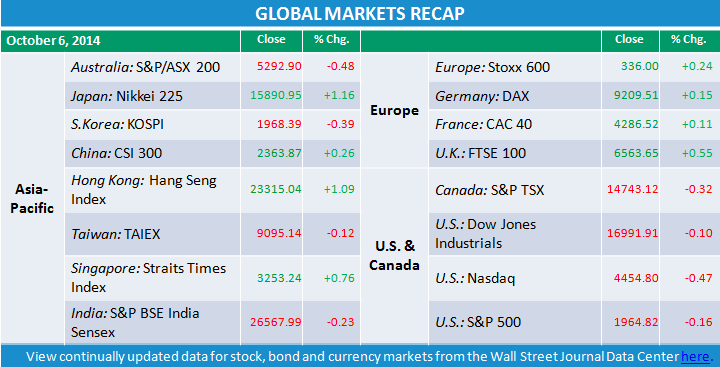
Download image to view market data.
Regulatory Update
New York bank regulator cites JPMorgan data breach in warning others
In the wake of a major data breach at JPMorgan Chase, New York state's top bank regulator is calling on various financial institutions' senior executives to discuss cyberthreats. Financial Times (tiered subscription model) (10/6)
Share: LinkedInTwitterFacebookGoogle+Email
Taiwanese regulator seeks to ease capital requirements for insurers
Taiwan's Financial Supervisory Commission aims to expand overseas investment opportunities for life insurance companies by introducing looser capital requirements. The move would free about NT$200 billion for investment. The Taipei Times (Taiwan) (10/6)
Share: LinkedInTwitterFacebookGoogle+Email
Economic Trends & Outlook
German factory orders in deep skid
German factory orders fell 5.7% in August, more than double the amount forecast and the sharpest decline in five years. The drop is thought to reflect a wider second-quarter slump and loss of confidence as the eurozone struggles and geopolitical tension continues to bubble up in Ukraine. Bloomberg Businessweek (10/6)
Share: LinkedInTwitterFacebookGoogle+Email
Profit growth slows at China's listed banks
China's listed banks posted an average 10.67% annualized rise in profit for the first half, down nearly 3 percentage points from the year-earlier gain. Net interest margin, meanwhile, was 2.5%, down 1.91 percentage points from a year before. Xinhuanet.com (China) (10/5)
Share: LinkedInTwitterFacebookGoogle+Email
Taiwan maintains steady growth outlook
For the seventh straight month, Taiwan's National Development Council reported stable economic growth in August. The composite score for the "green" signal was up two points with particular strength noted in the industrial production index and traditional electromechanical equipment imports. China Economic News Service (Taiwan) (10/6)
Share: LinkedInTwitterFacebookGoogle+Email
World Bank sees below-potential growth in Vietnam
The World Bank forecasts cooling inflation and a stable economy for Vietnam, with 5.4% growth this year ticking up to 5.5% in 2015. However, the bank notes missed potential for greater growth given low domestic demand and structural problems posed by Vietnamese banks and state-owned enterprises. Reuters (10/6)
Share: LinkedInTwitterFacebookGoogle+Email
Laos growth forecast raised
The World Bank raised its growth outlook for Laos' economy this year to 7.5% from the earlier 7.2%, citing stronger-than-expected performance of the wood and construction industries. In 2015, growth is expected to fall back to 6.4% before picking up again. Xinhuanet.com (China) (10/6)
Share: LinkedInTwitterFacebookGoogle+Email
Capital Markets & Financial Products
Hong Kong may get huge RQFII increase after Shanghai link
With Hong Kong hitting its RQFII quota ceiling, a major expansion is expected shortly after the Shanghai linkup. However, some aren't so certain, noting that nearly half of Hong Kong's current quota remains unused. AsianInvestor.net (10/6)
Share: LinkedInTwitterFacebookGoogle+Email
Investors have second thoughts on Indonesia
Signs that Indonesia's opposition is gaining increasing political strength are raising doubts about newly elected President Joko Widodo's ability to implement reforms and stocks are falling. The Jakarta Composite Index has fallen 3.3% this month after a coalition of opposition parties won the speakership of parliament, where the president's backers hold only 37% of the seats. Bloomberg (10/6)
Share: LinkedInTwitterFacebookGoogle+Email
Investors hesitate as more junk bonds come to market
Global investors are beginning to back away from low-yielding emerging-market and lower-grade European corporate "junk" bonds. Yields are up and prices down since the second quarter as a rush of new issues come to market. The Business Times (Singapore) (10/6)
Share: LinkedInTwitterFacebookGoogle+Email
People & Personalities
Richard Yacenda takes on additional Hong Kong role for BofA Merrill
Richard Yacenda has been named Hong Kong country executive by Bank of America Merrill Lynch. Yacenda, who will retain his title of Asia-Pacific chief operating officer, succeeds Jayanti Bajpai. FinanceAsia.com (Hong Kong) (10/6)
Share: LinkedInTwitterFacebookGoogle+Email
Subscriber Tools
Please contact one of our specialists for advertising opportunities, editorial inquiries, job placements, or any other questions.
 
Editor:  Sean McMahon
Contributing Editor:  Jim Berard


Download the SmartBrief App  iTunes / Android
iTunes  Android
Mailing Address:
SmartBrief, Inc.®, 555 11th ST NW, Suite 600, Washington, DC 20004
© 1999-2014 SmartBrief, Inc.®
Privacy policy |  Legal Information
 

Thursday, October 2, 2014

Fw: Edge #427 - Andrian Kreye - Salon Culture: Network of Ideas

Sent from my Verizon Wireless BlackBerry

From: "Edge" <editor@edge.org>
Date: Thu, 2 Oct 2014 10:55:13 -0700
To: Edge Mailing List<edge_editions@sand.lyris.net>
ReplyTo: "Edge" <editor@edge.org>
Subject: Edge #427 - Andrian Kreye - Salon Culture: Network of Ideas

Edge.org
October 2, 2014
http://www.edge.org

---------------------------------------------------
THE THIRD CULTURE
---------------------------------------------------

"Despite their intense scientific depth, John Brockman runs these gatherings with the cool of an old school bohemian. A lot of these meetings indeed mark the beginning of a new phase in science history. One such example was a few years back, when he brought together the luminaries on behavioral economics, just before the financial crisis plunged mainstream economics into a massive identity crisis. Or the meeting of researchers on the new science of morality, when it was noted that the widening political divides were signs of the disintegration of American society. Organizing these gatherings over summer weekends at his country farm he assumes a role that actually dates from the 17th and 18th century, when the ladies of the big salons held morning and evening meetings in their living rooms under the guise of sociability, while they were actually fostering the convergence of the key ideas of the Enlightenment."

Salon Culture

NETWORK OF IDEAS

By Andrian Kreye, editor of The Feuilleton (Arts & Essays), Süddeutsche Zeitung in Munich.

The Salon was the engine of enlightenment. Now it's coming back. In the digital era the question might be different from the ones in the European cities of the 17th century. The rules are the same. Why is there such a great desire to spend some hours with likeminded peers in this age of the internet?

Published in German and French by Entrepreneur Magazin (pp58-65). English translation by the author.
__________

SALON CULTURE: NETWORK OF IDEAS

For more than a century now the salon as a gathering to exchange ideas has been a footnote of the history of ideas. With the advent of truly mass media this exchange had first been democratized, then in rapid and parallel changes diluted, radicalized, toned down, turned up, upside and down again. It has only been recently that a longing emerged for those afternoons in the grand suites of the socialites in the Paris, Vienna, Berlin or Weimar of centuries past, where streams of thought turned into tides of history, where refined social gatherings of the cultured elites became the engine of the Enlightenment.

Just like back then, today's new salons are mostly exclusive if not closed circles. If you do happen to be invited though you will swiftly notice the intellectual force of those gatherings. On a summer's day on Eastover Farm in Connecticut for example, in the middle of green rolling hills with horse paddocks and orchards under the sunny skies of New England. This is where New York literary agent John Brockman spends his weekends. Once a year, he invites a small group of scientists, artists and intellectuals who form the backbone of what is called the Third Culture. Which is less of a new culture, but a new form of debate across all disciplines traditionally divided into the humanities and the natural sciences, i.e., the first and second culture.
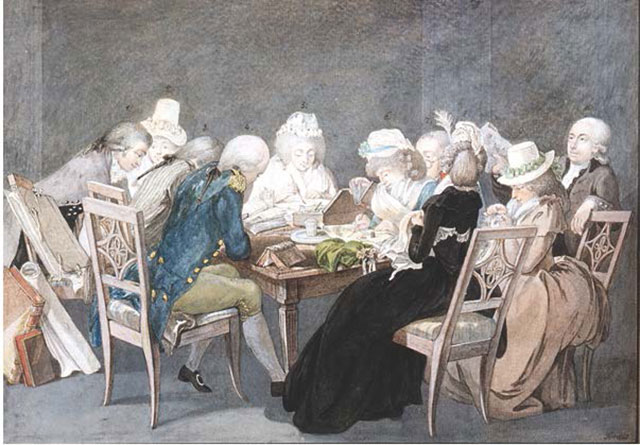

The salon, which marked a entire era: Duchess Anna Amalia of Saxe-Weimar with her guests, including Goethe (third from left) and Herder (far right).

On that weekend, for example, he had invited a half-dozen men. Each of whom had a large footprint in their respective disciplines: the gene researcher Craig Venter, who was the first to sequence the human genome; his colleague George Church, Robert Shapiro, who explored the chemistry of DNA, the astronomer Dimitar Sasselov, quantum physicist Seth Lloyd, and the physicist Freeman Dyson, who sees in his his role as scientist the need to continually question universally accepted truths. A few science writers were also present, along with Deborah Triesman, literary editor at the New Yorker.

At some of his other meetings, the number of Nobel Laureates might have been higher, but the question under discussion in the warm summer wind among rustling tops of maple trees with jugs full of freshly made lemonade, carried utmost weight: "What is life?" Seth Lloyd formulated the problem right at the start: science knows everything about the origin of the universe, but almost nothing about the origin of life. Without this knowledge, the sciences, on the threshold of the biological age, are groping in the dark. ...

... The salon is still regarded as a mysterious world of thoughts and ideas, a world in which the participants soon were consigned to the role of historical figures in history books. In the early days of the salon culture these meetings were incubators of new ideas as well as the first form an urban and bourgeois culture. The first salons were formed in Paris in the early 17th century, when the nobles left their estates and are gathered in the capital around the King. Initially, they cemented these early manifestations of bourgeois culture such as music and literature. But soon philosophers such as Voltaire and Diderot appeared in the 18th century and prepared the intellectual ground for the French revolution.

In all major cities in Europe, it soon was common for ladies of high society to gather influential thinkers around them. Often, these were for their time radical gatherings, because those salons dissolved the rigid boundaries between social classes. With rational thinking of the Enlightenment, the reputation enjoyed by a person was measured in terms of intellect, not status or wealth. Berlin and Vienna were established, next to Paris, as cities of culture of the salon. But in small towns too, the intellectual life soon revolved around salons. The salons in Weimar were legendary, where Johanna Schopenhauer, the mother of the future philosopher, Arthur, and the Duchess Anna Amalia of Saxe-Weimar-Eisenach, counted Johann Wolfgang von Goethe and Friedrich Schiller among their guests.

At the same time England developed the first coffee house culture. In 1650, the first English cafe, called Grand Café, opened in Oxford. The open structure of the cafés had a tremendous effect on the culture of debate, but so did coffee and tea, the new drinks from the colonies. In a country in which the entire population at any time of day was drinking alcohol, the stimulant of caffeine acted as fertilizer for the burgeoning idea cultures. But it was mostly the lounges and cafes in Europe (and later America) that gave birth to the fundamental principle of progress and innovation, namely the network. Indeed, it was rarely the sudden Eureka-moments in the solitude of the laboratory of the study, that scientists and thinkers brought humanity from the dark times of the pre-modern era into the light of reason. It was the fierce debates held in the lounges and cafes that allowed the ideas behind these Eureka-moments to mature. ...

Permalink: http://edge.org/conversation/salon-culture-network-of-ideas

---------------------------------------------------

IN THE NEWS

LATEST: http://edge.org/edgenews
HIGHLIGHTS: http://edge.org/edge-news-highlights

---------------------------------------------------

"Take a look. No matter who you are, you are bound to find something that will drive you crazy." --NEW YORK TIMES

---------------------------------------------------

Edge Foundation, Inc. is a nonprofit private operating foundation under Section 501(c)(3) of the Internal Revenue Code.

----------------------------------------------------
----------------------------------------------------
EDGE.ORG
John Brockman, Editor and Publisher
Russell Weinberger, Associate Publisher
Nina Stegeman, Editorial Assistant
Copyright (c) 2014 by Edge Foundation, Inc.
All Rights Reserved.
Published by Edge Foundation, Inc.
260 Fifth Avenue
New York, NY 10001
----------------------------------------------------

---

You are currently subscribed to the Edge.org mailinglist as: mainandwall@hotmail.com.

To unsubscribe send a blank email to leave-6539095-24407872.abf9ea0b85f64a2404bc566789218fc9@sand.lyris.net

Or, you can manage your subscription at the following URL:  http://edge.org/subscribe

Monday, September 29, 2014

Fw: "Glass Brain" Offers Tours of the Space between Your Ears

Sent from my Verizon Wireless BlackBerry

From: Scientific American Daily Digest <news@email.scientificamerican.com>
Date: Mon, 29 Sep 2014 17:08:55 +0000 (GMT)
To: <mainandwall@aol.com>
ReplyTo: news@email.scientificamerican.com
Subject: "Glass Brain" Offers Tours of the Space between Your Ears

3-D visualizations combine EEG and MRI data to illustrate how brain signals propagate and could be used to study neural disorders

To view this email as a web page, go here.
You received this email because you opted-in to receive email from Scientific American.
To ensure delivery please add news@email.scientificamerican.com to your address book.

Daily Digest
September 29, 2014
Scientific American
Twitter Facebook YouTube RSS Feeds iTunes Podcasts
“Glass Brain” Offers Tours of the Space between Your Ears
Read More
Top Stories News Health
No Airlifts for Sickened African Ebola Docs
West African physicians confront the same dangers as foreign health workers, but unlike their counterparts they do not receive emergency evacuations if they fall victim to the Ebola virus 
Scientific American Technology
Teen Wins Big for His Sock Invention
Recipient of the Science in Action Award, a 15-year-old develops a sensor to monitor Alzheimer’s patients
Scientific American More Science
Evolution versus Creation; Extinction of the Passenger Pigeon
Innovation and discovery as chronicled in past issues of Scientific American
Scientific American
October 2014

Scientific American Volume 311, Issue 4
Featured Products from Scientific American
Virtual Course Fermilab's Don Lincoln offers an inside look at the Higgs boson discovery and exciting new research in particle physics.
Drought, Water and the Rise of California Irrigation has created challenges as populations continue to grow
Multimedia More Multimedia » Advertisement

More Stories
Reuters At Least 36 Feared Dead on Japanese Volcano, Search Called Off
Climatewire Leaking CO2 Fails to Cause Marine Catastrophe
ChemistryWorld New Solar Cells Use Perovskite to Turn Water into Energy
Scientific American Mind Volume 25, Issue 5 Acting Classes Could Help Kids with Autism
Scientific American Volume 311, Issue 4 Book Review: Alive Inside
Scientific American Volume 311, Issue 4 When I Learned the Value of Diversity for Innovation
Advertisement
Scientific American Volume 311, Issue 4 Scientists Draw on Personal Experience to Guide Their Curiosity
Symbiartic Now That’s a Wee Little Infographic
Food Matters Chef Meets Doctor
Plugged In Map Monday: Will Global Warming Drown Your Hometown?
Information Culture Scholarly articles and other sources about the Ebola outbreak
Tetrapod Zoology Neat news from the TetZoo-sphere
Beautiful Minds What Kind of Introvert Are You?
Roots of Unity Another Reason to Love the Number Seven
Cocktail Party Physics Manh(a)ttan Recap: Cracking the Implosion Case [SPOILERS]
Talking back A New Idea for Treating Alzheimer’s
Dog Spies Game Boy, Pimples and Archie Comics: Before They Were Scientists
The White Noise Between Homelessness and Psychiatric Hospitals
Cocktail Party Physics Physics Week in Review: September 27, 2014

Unsubscribe | Manage Email Preferences | FAQs | Terms & Conditions | Privacy Policy | Contact Us

This message was sent to: mainandwall@aol.com

Check out our New Products!

Scientific American
75 Varick St
New York, NY, 10013

Scientific American is a trademark of Scientific American, Inc., used with permission
© 2014 Scientific American, a division of Nature America, Inc.

Fw: [New post] Do Valuation Shorts Work?

Sent from my Verizon Wireless BlackBerry

-----Original Message-----
From: Enterprising Investor <donotreply@wordpress.com>
Date: Mon, 29 Sep 2014 05:05:20
To: <mainandwall@gmail.com>
Subject: [New post] Do Valuation Shorts Work?

Post : Do Valuation Shorts Work?
URL : http://blogs.cfainstitute.org/investor/2014/09/29/do-valuation-shorts-work/
Posted : September 29, 2014 at 1:04 am
Author : Alon Bochman, CFA
Tags : fraud, short selling, stocks
Categories : Drivers of Value, Equity Investments, Investment Topics, Portfolio Management

Valuation shorts have a bad reputation on Wall Street. But do they work? Alon Bochman, CFA, tested this question using a new research service.

Read more of this post ( http://blogs.cfainstitute.org/investor/2014/09/29/do-valuation-shorts-work/ )

Add a comment to this post: http://blogs.cfainstitute.org/investor/2014/09/29/do-valuation-shorts-work/#respond

--


Manage Subscriptions
https://subscribe.wordpress.com/?key=f8226ec4a5ae3afce1809a627c3c9b55&email=mainandwall%40gmail.com

Unsubscribe:
https://subscribe.wordpress.com/?key=f8226ec4a5ae3afce1809a627c3c9b55&email=mainandwall%40gmail.com&b=Cuz.%3FrdZFY%26l%5ByolO3tbgN7npP4GhG9Z9aDGlB%2F%5D%5Dyt6Z%262%3D%7C4G

Fw: A Common Meditation for All Souls--Sunday, September 28, 2014

Sent from my Verizon Wireless BlackBerry

From: "Rev. Galen Guengerich" <webmaster@allsoulsnyc.org>
Date: Sun, 28 Sep 2014 01:01:50 -0700
To: Bob Sefcik<mainandwall@gmail.com>
ReplyTo: <webmaster@allsoulsnyc.org>
Subject: A Common Meditation for All Souls--Sunday, September 28, 2014


A Common Meditation for All Souls

Sunday

The human mind, in its desire to know, understand, and control, mistakes its opinions and viewpoints for the truth. It says: this is how it is. You have to be larger than thought to realize that, however you interpret "your life" or someone else's life or behavior, however you judge any situation, it is no more than a viewpoint, one of many possible perspectives. It is no more than a bundle of thoughts. But reality is one unified whole, in which all things are interwoven, where nothing exists in and by itself. Thinking fragments reality; it cuts it up into conceptual bits and pieces. The thinking mind is a useful and powerful tool, but it is also very limiting when it takes over your life completely, when you don't realize that it is only a small aspect of the consciousness that you are. Wisdom is not a product of thought. The deep knowing that is wisdom arises through the simple act of giving someone or something your full attention. Attention is primordial intelligence, consciousness itself. It dissolves the barriers created by conceptual thought, and with this comes the recognition that nothing exists in and by itself. It joins the perceiver and the perceived in a unifying field of awareness. It is the healer of separation.


(Eckhart Tolle, 1948 - ) 
 

This is the day we are given;
Let us rejoice and be glad in it.

           
                                                                                       Galen


The instructions for this meditation practice can be found anytime here.

If you received this meditation from a friend or family member,
and would like to subscribe,
click here.

1157 Lexington Avenue, New York, NY 10075        (212) 535-5530
www.allsoulsnyc.org         www.facebook.com/AllSoulsNYC


Unsubscribe from this mailing.